Self-Propelled Grader Shipped to Southeast Asian Contractor

What shipped
The unit is the production version of the self-propelled grader we build for farm, plantation and estate work: a four-wheel chassis, a diesel engine, an open operator station with a steering wheel and a lever group for the blade functions, and a moldboard that is raised, tilted and swung from the seat.
The blade sits in a bolted turntable, so its working angle can be reset for a different job - a light finish pass on a drying floor, a full cut on a new bench, or an angled pass that windrows loose soil to the edge of a road.
| Model | 100HP |
| Dimensions | 7.2×2×2.9m |
| Total Weight | 4000kg |
| Blade Size | 3000-3200*500mm |
| Cutter Diameter | 1200mm |
| Blade Turning | 260° |
| Cutting Depth | 100mm |
| Blade Tilt Angle | F40°/R5° |
| Blade Moving | L/R 500mm |
| Engine Model | HUAJIE |
| Rated Power | 78KW |
| Gear Shift | 4F,4R |
| Forward Speed | 40km/h |
| Reverse Speed | 10km/h |
| Hydraulic System | 16Mpa |
| Tyre | 16/70-20 |
| Operating System | Mechanical |
Why self-propelled
A self-propelled grader is a machine that carries its own engine, transmission and operator station, with a steel moldboard that cuts, spreads and levels soil. Nothing has to be hitched to a tractor, so the machine can be moved between sites on a trailer and put to work within minutes of arrival.
On an estate, that difference is practical rather than cosmetic:
The tractor stays free. Blade work no longer competes with spraying, hauling fruit bunches or running the mill road. Levelling can be done in the week it is actually needed, not in the week the tractor is spare.
Blade control sits with the operator. Lift, tilt and swing are worked from the seat, so a full cut can be feathered into a finish pass on the same stretch.
Angled passes move material. With the moldboard swung off square, one pass both levels the surface and pushes the loose soil to the shoulder, which is how a camber or a drain edge is formed.
It fits between rows. A short wheelbase and a blade that does not need a tractor in front of it let the machine work a plantation inter-row, a bund or a yard corner where a tractor-and-blade combination cannot line up.
One operator. Drive and blade are handled from the same seat; no second person walks behind the blade.
Working on wet ground
Most of the enquiries we receive from Southeast Asia are about ground that is soft for part of the year - oil palm and rubber estates, paddy areas, and yards that turn to clay in the monsoon. Three details of the machine are aimed at that:
Wide lugged tyres spread the load and keep rolling resistance down on damp soil, so the machine can keep working after rain instead of waiting for the ground to dry.
Hydraulic blade control lets the operator take a shallow first cut and deepen it once the surface is opened, rather than loading the machine with a full-depth pass on soft ground.
Bolt-on cutting edges are replaced individually with hand tools, which matters where the soil carries grit and the edges wear faster than the rest of the blade.
The machine is painted and the exposed pins and linkages greased before loading, and a spare set of cutting edges travels with it. For the sea passage, a moisture barrier goes into the container against condensation.
Checks before loading
Every unit follows the same sequence. For this machine it was:
Cold start, idle and a run-in under load, with the engine brought up to working temperature.
Blade cycled through full lift, tilt and swing to confirm each cylinder holds position without creeping.
Hydraulic lines, fittings and hoses checked for seepage after the run-in.
Cutting edges checked for bolt torque; the turntable bolts re-torqued.
Tyre pressures set, wheel nuts checked.
Fasteners checked throughout; paint touched up where straps and timber sit.
Moldboard and cutting edges coated with rust preventive.
Operator manual, spare parts list and tool kit packed with the machine.
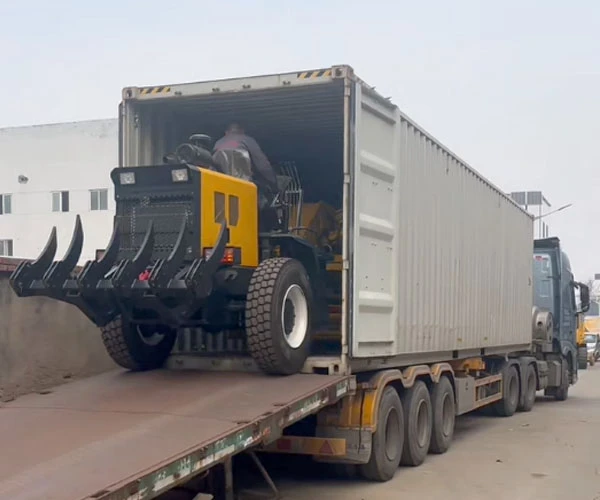
Machine strapped to the container floor with timber bracing against the side walls.
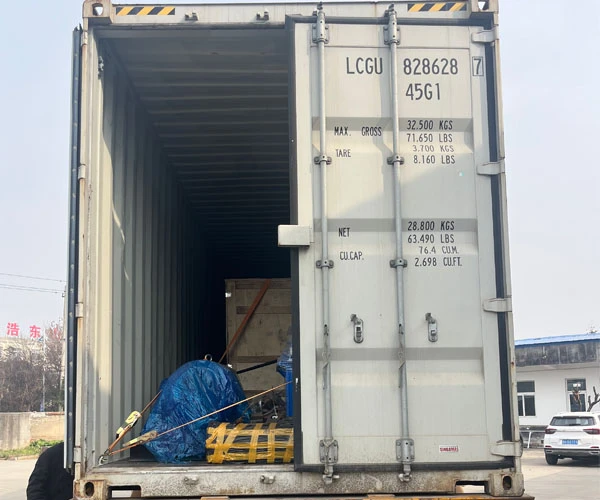
Door-end photographs taken and filed with the packing list before the container was sealed.
Export loading: the machine is strapped to the container floor with timber bracing against the side walls and a moisture barrier against condensation.
Common questions
What can a self-propelled grader do on a plantation?
It levels and shapes ground: estate and mill roads, loading bays, nursery beds, drying floors, house compounds and new planting blocks. With the blade angled it also forms camber, clears a drain edge and spreads stockpiled soil or gravel. On established oil palm and rubber estates the usual work is keeping roads passable through the wet season.
Does it need a tractor to pull it?
No. The machine has its own engine and drives itself; the operator controls travel and blade from the seat. It is moved between sites on a low-bed trailer, and the machine can be driven on and off under its own power.
How is it shipped?
As a complete machine inside a [40HQ] container, strapped to the floor and braced against the side walls, with a moisture barrier against condensation. The container is photographed at the door end before sealing, and those photographs are sent to the buyer with the packing list and the shipping documents.
Door-end photographs are taken and filed with the packing list before the container is sealed.
Order the same configuration
Tell us the job - road maintenance, land leveling, drainage or bench cutting - plus the soil type and the area you need to cover in a season. We will confirm the moldboard width, the engine rating and the container loading plan, then send the price and lead time.
For the full specification, the blade options and the spare parts list, see the self-propelled grader page.