


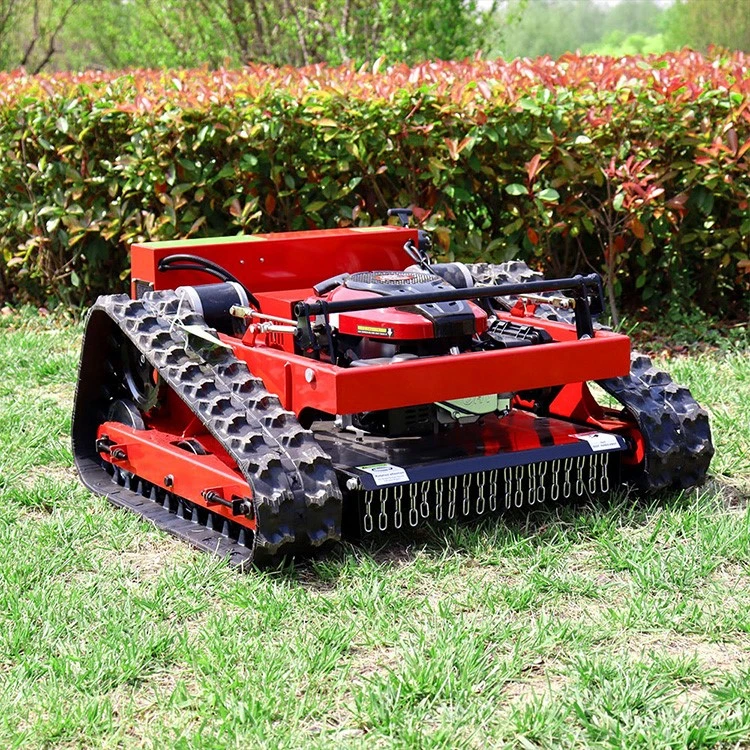
Core maintenance concept: Preventive maintenance > Fault repair (Statistics: Regular maintenance can reduce the repair rate by 60%)
1. Daily use and maintenance specifications for remote control lawn mowers
Post-operation cleaning procedures
Disc cleaning: Use a hard brush to clean the grass clippings after each operation (retained grass juice corrodes metal)
Chassis flushing: Use ≤40°C low-pressure water flow for flushing (high-pressure water guns are prohibited from aiming at sensors)
Ventilation dust removal: Compressed air cleans the motor heat dissipation port (at least once a week)
Warning case: German user's motor overheated and burned due to grass clippings clogging (repair cost €280)
Scientific battery management
Charging cycle: Discharge to 20% and charge immediately
Long-term storage: Keep 50% power for storage, and recharge every 3 months
Temperature management: Working environment: -10℃~40℃; Charging environment: 5℃~35℃
Blade system maintenance
Self-check method: Use A4 paper to draw across the blade, if it is not cut, it needs to be polished
Replacement cycle: Carbon steel blades are replaced every 50 hours, titanium alloy blades can reach 150 hours
Balance test: New blades must be tested for static balance (deviation > 0.5g causes vibration of the machine body)
2. Periodic deep maintenance of remote control lawn mowers (by time/operation volume)
Monthly maintenance list
Tire pressure calibration: Maintain 1.8±0.2bar (low pressure causes path deviation of 12%)
Joint oiling: lithium-based grease is injected into the transmission shaft (oil injection amount ≤ 3ml)
Boundary line detection: use a multimeter to measure the wire resistance (standard value 3-8Ω/100m)
Annual maintenance Main control board dust removal: clean the circuit board with 75% alcohol cotton pads
Motor carbon brush replacement: must be replaced when the remaining wear is 5mm Sealing test: 1m water immersion test (no leakage for 30 minutes)
3. Seasonal storage strategy for remote control lawn mowers
Winter out of use period (<5℃ environment)
Six-step sealing method: ① Completely discharge to 15% → ② Disassemble the battery and store it separately → ③ Apply anti-rust grease to the blade ④ Store the tire off the ground → ⑤ Cover the body with a dust cover → ⑥ Dry storage (humidity ≤ 60%)
Spring activation process:
1: Recharge the battery to 100% (new and old batteries need to be charged and discharged three times to activate)
2: Upgrade firmware (outdated systems are prone to GPS drift)
3: Reset boundaries (melting permafrost may cause landmark displacement)
4. Special maintenance of remote control lawn mower intelligent system
Navigation system calibration
RTK base station: calibrate ephemeris data every six months
Compass calibration: perform "8-character calibration method" in an open space of 3m²
Fault code interpretation: ERR07 = GPS signal is weak; ERR15 = Gyroscope offset Sensor maintenance
Ultrasonic probe: wipe with anhydrous alcohol cotton pad; standard obstacle distance test
Rain sensor: dry wipe with microfiber cloth; spray test reaction speed
Tilt sensor: liquid contact is prohibited; level gauge assists adjustment
5. Remote control lawn mower safety red line (absolute prohibition)
Live maintenance: the battery physical connection must be disconnected during disassembly
Wet hand operation: the circuit board operating voltage reaches 48VDC
Over-level replacement: do not use non-standard parts to replace original accessories
Unauthorized modification: adding accessories with power > 10% will cause overload


