


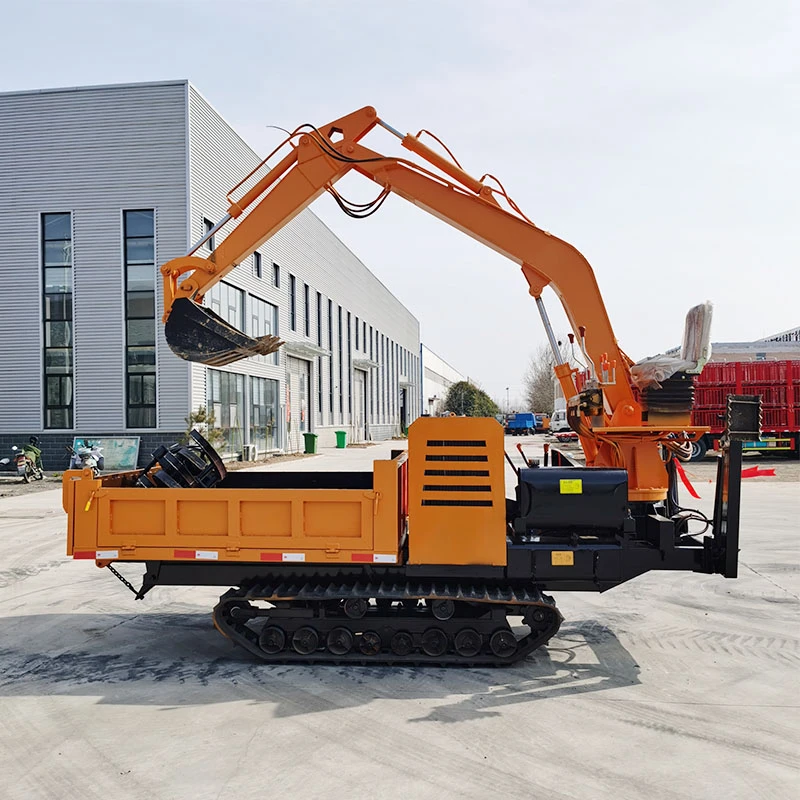
Key points of crawler transport vehicle maintenance
1. Daily maintenance and pre-start inspection of crawler dump trucks
Comprehensive equipment inspection
Fastening parts: Check whether the connecting bolts, supporting wheels, guide wheels, and drive gear blocks of the fuselage are loose or worn before operation, and reinforce or replace them in time.
Leakage investigation: Check whether the engine, hydraulic pipeline, and fuel tank have oil leakage to ensure sealing.
Track status: Observe whether the track plate is broken or worn beyond the limit, and remove gravel and mud in the gap of the track (clean after each shift).
Lubrication system maintenance
Lubrication of key parts: Add lubricating oil to bearings, chains, guide rails and other parts (performed before each shift) to reduce friction loss.
Grease gun use: Regularly add grease to the track tensioning cylinder to keep the track droop within 10-20mm.
2. Key points for maintenance of crawler dumper truck key systems
Engine maintenance
Oil management: Replace the oil after 20 hours of first use, and replace it according to the manual (generally 100-200 hours). Use national standard CD40 or CF grade diesel engine oil, and keep the oil level at 1/3 to 2/3 of the oil dipstick scale.
Filter maintenance: The air filter is cleaned of dust every 3-5 days, and the oil filter element is regularly cleaned with diesel (no water).
Hydraulic system maintenance
Hydraulic oil replacement: Filter the oil for the first refueling, and check the oil quality regularly (black, turbid, milky white, need to be replaced immediately).
Oil temperature control: In low temperature environment (<10℃), run it without load first to heat it up to avoid damage to hydraulic components.
Gearbox and travel mechanism
Gear oil replacement: Replace the gear oil every 15 days for the first time, replace it every month for the second time, and check it regularly afterwards.
Operation specification: When turning, the steering rod must be returned to the center before operation; the clutch must be stepped on before shifting gears to prevent gear damage.
3. Special maintenance of tracks
Tightness adjustment
Detection method: Support the track on one side and measure the distance between the upper edge of the track plate and the lower edge of the lower frame (refer to the manufacturer's standard, such as the droop of Kobelco models is 30-50mm).
Adjustment operation:
Tighten: Grease the guide wheel nozzle with a grease gun until the tension is moderate.
Loosen: Slowly loosen the nozzle (≤1 turn) to release the grease to avoid the danger of high-pressure splashing.
Environmental adaptation:
Pebbles/sand ground: Loosen the track to prevent derailment;
Hard ground: Tighten the track to improve stability.
Rust prevention and cleaning
When parking for a long time, clean the track and do rust prevention treatment, and remove hard objects (such as stones and metal fragments) in the track every day.
4. Targeted maintenance for different working environments
Mines/tunnels: It is forbidden to disassemble hydraulic components underground; check the blockage of mufflers and filters every shift.
Muddy/paddy fields: Clean the chassis mud and sand every day; check the sealing of the battery; use waterproof grease for lubricating parts.
Low temperature/snowy areas: Use low-condensation hydraulic oil; preheat the engine before starting; tighten the track to prevent slipping.
5. Fault prevention and safety regulations
Operation taboos
Avoid sharp turns or sudden speed changes on slopes to reduce wear on rail chain links.
It is forbidden to mix different brands of hydraulic oil or mix new and old to prevent oil quality deterioration.
Emergency treatment
Abnormal noise/odor during operation: stop the machine for inspection immediately;
Abnormal oil pressure (not restored after 6 seconds of starting): shut down the engine for inspection.


