


1. Industry definition and core value
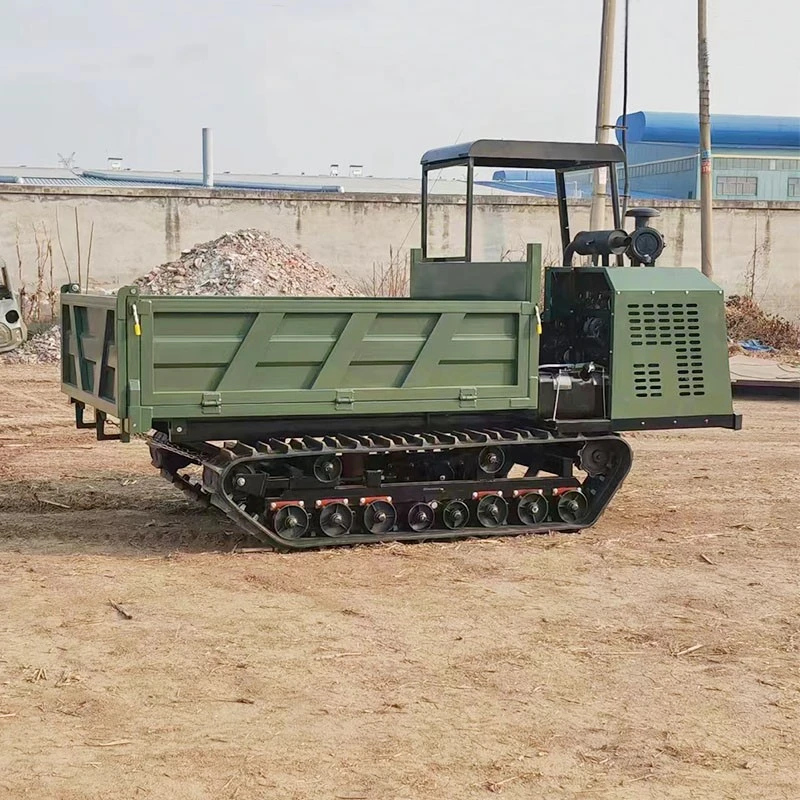
Crawler transport vehicles are special transport equipment that replace wheeled walking mechanisms with crawlers. With high load-bearing capacity, strong terrain adaptability and low ground pressure, they have become the core tool for transportation in complex environments. Its core value is reflected in:
Terrain adaptability: Maintain stable driving in areas where wheeled vehicles cannot pass, such as mud, steep slopes, and mining areas.
Functional diversity: According to their use, they can be divided into mining type (high load-bearing), engineering type (flexible loading and unloading), agricultural type (low-damage ground) and military type (battlefield support).
Environmental upgrade: Electric and hybrid models reduce noise and emissions, in line with the trend of green construction.
2. Development history and market size
1. Technology migration from military to civilian use
Origin: Designed to meet battlefield transportation needs in the early 20th century, the technology spread to the civilian field after World War II.
China's industrialization: In 1979, Caterpillar and Komatsu technologies were introduced, and the country has achieved the transition from imitation to independent innovation. The current localization rate exceeds 80%.
2. Steady growth of the global market Scale: The global market size will reach US$685 million in 2023, and is expected to exceed US$994 million in 2030 (CAGR of 5.28%).
III. Technological evolution and innovation trends
1. Intelligence and automation IoT integration: Real-time monitoring of equipment status, remote fault diagnosis, and reduction of downtime by more than 30%.
Automatic driving: Takeuchi and other companies have launched L4 unmanned mining transport vehicles to adapt to 24-hour operations.
2. New energy power revolution Electrification penetration: The proportion of electric/hybrid models will increase from 10% in 2025 to 25% in 2030, and hydrogen energy technology will enter the trial stage. Lightweight design: Carbon fiber tracks and aluminum alloy bodies reduce the weight by 20% and improve energy efficiency.
3. Modular customization Configuration on demand: Shandong Hengwang and other companies provide universal chassis that can be replaced with agricultural tools, cargo boxes or rescue equipment to meet the needs of multiple scenarios such as agriculture and firefighting.
IV. Application scenarios and demand analysis
Infrastructure projects: bridge and tunnel material transfer;
Mining: high load-bearing and corrosion-resistant;
Modern agriculture: low ground damage and multi-functional integration;
Military logistics: all-terrain mobility and rapid deployment;
V. Challenges and future opportunities
1. Core challenges
Technical bottlenecks: high-end hydraulic transmission systems and long-life batteries rely on imports.
Homogeneous competition: imitation by small and medium-sized manufacturers leads to price wars, and profit margins are compressed to 8%-12%.
2. Growth momentum
Policy drive: China's "Belt and Road" infrastructure output and the EU green machinery standard (Stage V) have spawned demand for updates.
Emerging markets: Mining expansion in Southeast Asia (nickel mines in Indonesia), increase in transportation scenarios for oil fields in the Middle East desert.
Technology integration: "5G+Beidou" high-precision positioning promotes cluster operations of unmanned vehicle fleets (Sany Heavy Industry demonstration project).
Conclusion: Leap to intelligence and sustainability The crawler transporter industry is undergoing a transformation from "mechanical tools" to "intelligent solutions". The future winner will depend on: the maturity of new energy technologies (such as the reduction in the cost of hydrogen fuel cells), data value mining (operation and maintenance big data monetization) and local penetration in emerging markets (such as the layout of African assembly plants). Enterprises need to find a balance between technology research and development and deep cultivation of scenarios in order to gain an advantage in the wave of green intelligent manufacturing.


