


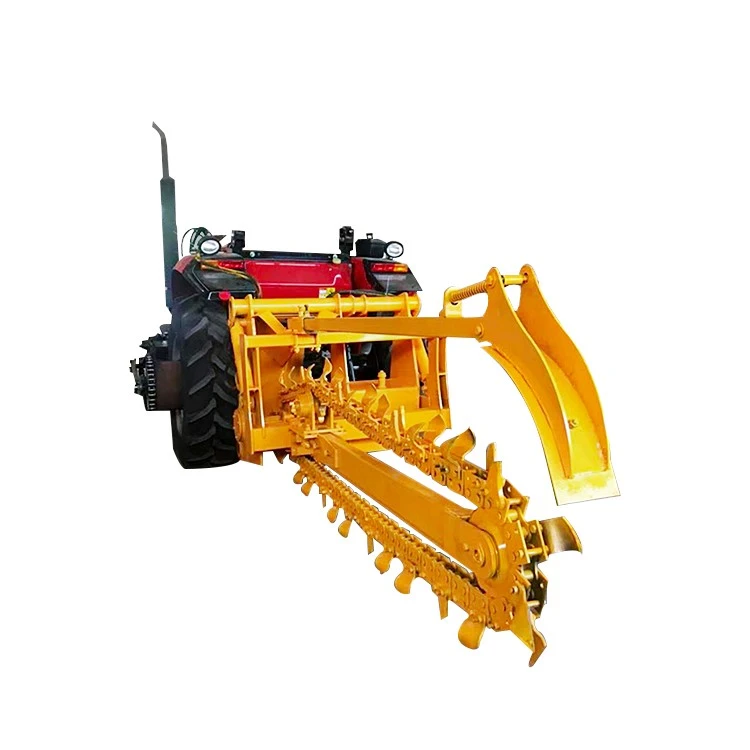
1. Definition and core structure
The tractor-driven chain trencher is an efficient and dedicated agricultural machinery, mainly used for digging narrow and deep trenches, suitable for farmland irrigation, underground pipeline laying, cable burial and other scenarios. Its core structure consists of four major systems:
Power system: Usually equipped with a diesel engine, the power is transmitted to the reduction device through a belt or hydraulic transmission.
Reduction system: A gearbox or a turbine reducer is used to convert the high speed of the tractor into a low speed, high torque output to ensure the stable operation of the chain.
Chain drive system: The main sprocket drives the chain installed with the tool to rotate, combined with the translation to achieve soil cutting, and the trenching depth can reach 1.5-2 meters.
Soil separation system: The crushed soil is evenly discharged out of the trench through spiral blades or soil throwing discs to reduce the workload of backfilling.
2. Working principle and operation characteristics
The chain trencher is driven by a tractor or self-propelled. The tool is driven by the chain to cut the soil with a "rotation + translation" compound motion to form a regular trench. Its notable features include:
High efficiency: The operating speed can reach 100-700 meters per hour, which is dozens of times that of manual labor and 3-5 times that of small excavators.
Accuracy: The ditch width can be adjusted to 10-55 cm, the ditch depth can reach 1.5-2 meters, and the ditch wall is steep and uniform in size, meeting the requirements of "minimally invasive" construction.
Adaptability: It supports single and double chain modification, can cope with various geological conditions such as clay and sand, and is used with 20-140 horsepower tractors.
3. Application fields and market demand
Agricultural scenarios: excavation of farmland drainage ditches, laying of drip irrigation pipes, excavation of fertilization ditches for fruit trees, etc.
Infrastructure fields: urban and rural optical cable burial, tap water pipeline construction, especially suitable for projects that need to avoid large-scale damage to the road surface.
Market growth: The scale of the Chinese market continues to expand, and it is expected to exceed 5 billion yuan in 2024. Policy subsidies promote procurement by small and medium-sized farms.
4. Technical advantages and industry pain points
Advantages:
Economical efficiency: A single device can replace dozens of workers, reducing manpower and time costs.
Durability: The cutter is made of special alloy steel, and the chain is hardened, which significantly extends its life.
Flexible modification: It supports the installation of ultra-low speed transmission (creep gear) to adapt to ordinary tractor upgrades.
Challenges:
High-power models (>100 horsepower) have high fuel consumption and maintenance costs;
Complex geology (such as rock layers) requires customized cutters, which increases construction costs.
5. Development trends and innovation directions
Intelligent upgrade: Integrated GPS navigation and automatic depth adjustment system to achieve centimeter-level precision operations.
Green design: Use biomass composite material components to reduce energy consumption and carbon emissions.
Multi-functional expansion: Develop integrated models of trenching, fertilization and sowing to improve overall efficiency.
Global layout: Emerging markets such as Southeast Asia and Africa have become export growth points, and the construction of localized service networks has accelerated.


