

I. Introduction
With the continuous improvement of winter road maintenance needs, snow melting spreaders, as an important equipment for winter road snow removal and smooth traffic, have received increasing attention for their technical development and application. This article will comprehensively analyze the snow melting spreader from the aspects of technical principles, structural composition, performance parameters, application scenarios and development trends.
II. Working principle of snow melting spreader Snow melting spreader is a mechanical equipment specially used for road snow removal and anti-skid. Its core working principle is to evenly spread solid snow melting agent (such as sodium chloride, calcium chloride, etc.) on the road surface through mechanical devices. Modern snow melting spreaders usually use centrifugal spreading technology to evenly spread snow melting agent particles through high-speed rotating spreading discs to achieve efficient coverage.
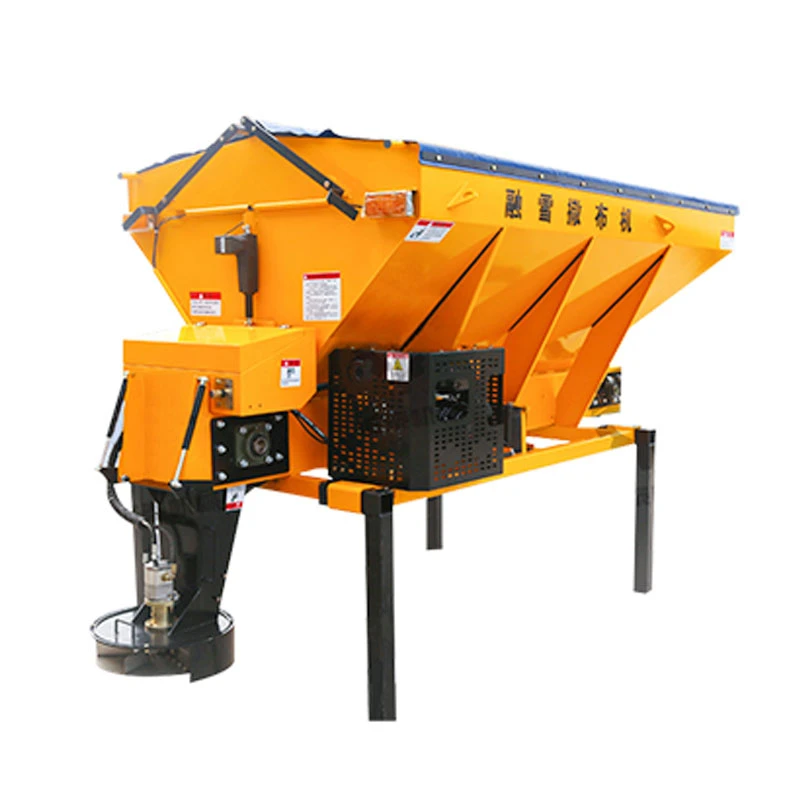
III. Main structural components
Storage system: including silos, material door control devices, etc., with a capacity ranging from 1-10 cubic meters.
Conveying system: screw conveyor or belt conveyor, responsible for conveying snow melting agent to the spreading mechanism.
Spreading system: core components, including spreading disc, drive motor and control system.
Power system: hydraulic drive or mechanical drive mode.
Control system: modern models mostly use PLC or microcomputer control, which can achieve precise adjustment of spreading amount.
IV. Key technical parameters
Spreading width: 3-15 meters adjustable;
Spreading amount: 5-200g/m² adjustable;
Operation speed: 15-50km/h;
Binage capacity: 1-10m³;
Control accuracy: within ±5%;
V. Application scenario analysis
Urban roads: respond to sudden snowfall and ensure smooth traffic.
Highways: preventive spreading to prevent road icing.
Airport runways: high precision requirements to ensure aviation safety.
Bridges and tunnels: key anti-skid areas, requiring special treatment.
Mountain roads: steep slopes and sharp bends, with high anti-skid requirements.
VI. Technology Development Trends
Intelligent Control: Application of GPS positioning and Internet of Things technology to achieve precise spreading.
Environmentally friendly design: Reduce the dispersion of snowmelt and reduce environmental impact.
Multi-function integration: Integration with snowplows, water sprinklers and other functions.
New Energy Application: Promotion of electrification and hybrid technology.
Material Innovation: Lightweight design to improve transportation efficiency.
VII. Key Points of Operation and Maintenance
Operation Specifications:
Adjust the spreading amount and width according to the road conditions.
Maintain a constant speed to ensure uniform spreading.
Pay attention to the influence of wind speed and direction on the spreading effect.
Maintenance:
Clean up the residual snowmelt in the equipment in time after operation.
Regularly check the conveying system and spreading mechanism.
Lubricate key moving parts.
Do a good job of rust prevention before winter storage.
VIII. Conclusion
With the advancement of technology and the improvement of environmental protection requirements, snowmelt spreaders are developing in the direction of intelligence, precision and environmental protection. In the future, combined with big data analysis and autonomous driving technology, snow melting and spreading operations will be more efficient and accurate, providing stronger protection for winter road safety. At the same time, the research and development of new environmentally friendly snow melting agents will also promote further innovation in equipment technology.


