


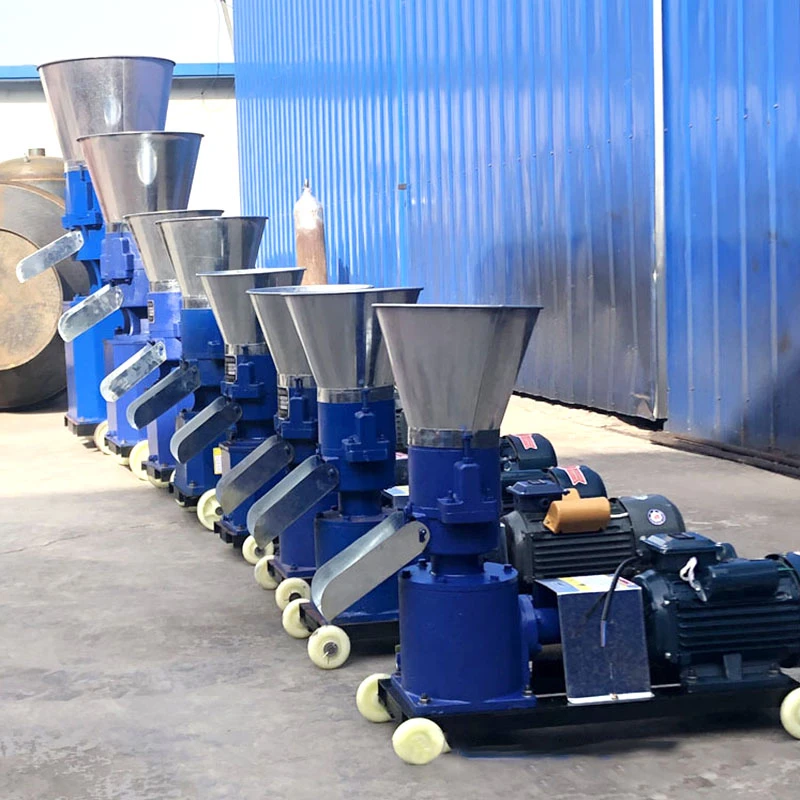
Current Status of Feed Pellet Machine Industry Development
The global feed pellet machine market is expected to exceed 38 billion yuan in 2025, with China contributing more than 35% of the production capacity. The industry presents a "polarized" development: large groups tend to prefer intelligent ring die production lines (single-line capacity ≥ 15t/h), while small and medium-sized farms prefer flat die equipment (investment cost < 80,000 yuan). Core technology innovation focuses on three major directions:
1. Energy efficiency improvement: The conical pressure wheel design reduces the power consumption per ton of material to 12kWh, which is 40% energy-saving compared with traditional models.
2. Material innovation: The service life of the bimetallic composite ring die is up to 5000 hours, and the laser cladding technology makes the roller hardness exceed HRC60.
3. Intelligent control: The PLC system achieves a feeding error of ±1.5%, and the accuracy of the IoT fault warning exceeds 97%.
Key technology classification and application
Type Applicable scenarios Core advantages Representative parameters Ring die pellet machine Large feed factory High production capacity (30t/h) Die hole diameter 2-12mm Flat die pellet machine Family farm Simple structure (220V power supply) Moisture content ≤15% Biomass machine model Straw recycling and utilization Crude fiber processing capacity ≥25% Molding temperature 75-90℃.
Industry challenges and breakthroughs
1. Raw material adaptability: The new conditioner is compatible with oil-containing materials (addition amount ≤3%) and high-fiber raw materials.
2. Maintenance cost: The self-lubricating bearing system extends the maintenance cycle to 2000 hours.
3. Lack of standardization: The "Feed Machinery Energy Efficiency Rating" implemented from 2024 will promote industry reshuffle.
Future trend forecast
Biomass fuel: The demand for straw pellet processing equipment may increase by 50% in 2026;
Modular design: The quick-release mold system will reduce the mold change time to within 30 minutes;
Low-carbon technology: The energy consumption of the hydrogen heating system will be reduced by another 12% during the test phase.


