


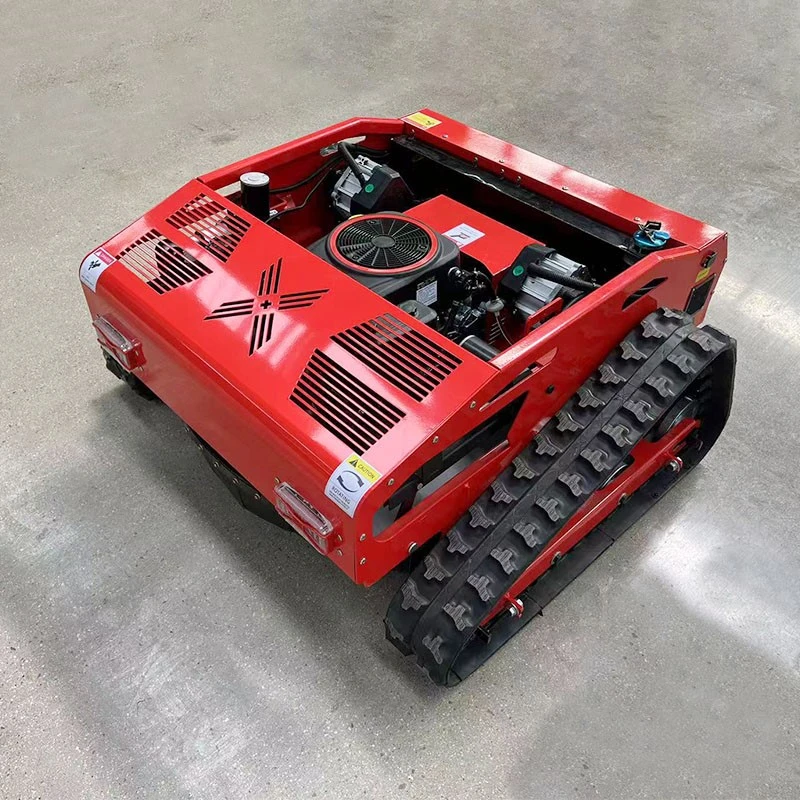
Ⅰ. Daily maintenance: key actions before and after use
Must check before use (5 minutes to protect safety)
Blade status: Check whether the blade is sharp, has no gaps or deformation. Blunt blades will tear grass leaves and cause diseases. It is recommended to polish them every 10 days. Severe wear needs to be replaced immediately.
Tire and air pressure: Make sure the tires are not damaged and have sufficient air pressure. Low pressure will cause unstable travel and increase the load on the motor.
Remote control system: Confirm that the remote control has sufficient power (≥60%), the buttons are responsive, and there is no delay in signal reception.
Obstacle removal: Clear the lawn of stones, branches and other hard objects before operation to avoid damage to the blades.
Specifications during use (avoiding damage risks)
Height and speed: Adjust the mowing height according to the grass species (it is recommended to keep 5-8cm), and use low speed for complex terrain.
Environmental avoidance: It is strictly forbidden to operate in rainy days, strong winds or high temperatures (>35℃) to prevent circuit short circuit and motor overheating.
Collision prevention: Observe the path in real time and remotely control the steering in advance when encountering obstacles. Immediately stop the machine for inspection after a severe collision.
Cleaning after operation (extending core life)
Body cleaning: Use a soft cloth or brush to remove grass clippings and sludge from the chassis and blade. High-pressure water gun flushing is prohibited to avoid damaging the circuit.
Blade maintenance: Disassemble the blade to remove residual grass juice (anti-corrosion), and wipe the oily area with a neutral detergent.
Filter maintenance: Clean the air filter once a week - dust the paper filter element, clean the sponge filter element with gasoline and then drip lubricating oil for moisturizing.
Ⅱ. Regular deep maintenance: life cycle management of key components
Oil change: First 5 hours + 10 hours, and every 150 hours thereafter, release the old oil in the hot engine state, use 40W-50W in summer and 5W-30W in winter.
Gear oil replacement: Every 150 hours, the cutter and gearbox are changed synchronously (HL-20 gear oil), and the inner cavity is cleaned with kerosene before filling.
Battery maintenance: Every month (idle period), lead-acid batteries need to be charged regularly (4 hours/time), and lithium batteries are stored at 40%-60% power.
Belt/transmission inspection: Every 50 hours, adjust the tightness to press and sink 10mm, and replace cracks and wear in time.
Spark plug maintenance: Every 300 hours, clean the electrode carbon deposits, adjust the gap (0.6-0.9mm in winter, 0.9-1.0mm in summer), and replace the same model if it fails.
Ⅲ. Seasonal maintenance: winter storage and spring awakening
Winter storage (critical period for antifreeze and moisture protection) Thorough cleaning: Rinse the chassis grass clippings, wipe dry with a soft cloth, and spray rust inhibitor.
Oil circuit management: Drain the gasoline in the tank, start the engine until it shuts down (empty the carburetor), and inject 1-2ml of two-stroke oil into the cylinder.
Battery handling: Disconnect after charging to 60%, and store in a dry environment.
Storage environment: Place in a ventilated room, cover with a dust cover, and keep away from heating and wet ground.
Spring activation (restart safety verification) Replace fresh gasoline (95# unleaded gasoline is preferred), and check the oil level.
Test the remote control signal and emergency brake function, and calibrate the balance of the blade.
If the garden layout is changed (such as adding a new path), it is necessary to re-map and locate.
Ⅳ. Common fault self-diagnosis: Quick response guide
Engine starting difficulty: lack of oil, spark plug failure, filter blockage, add 95# gasoline, clean/replace spark plugs, and clean air filter.
Severe shaking during operation: blade deformation/imbalance, crankshaft bending Stop the machine to check the blade, correct or replace; tighten the base screws.
Uneven mowing effect: Blade blunting, wrong height setting, sharpen or replace blade, adjust cutter height.
Remote control signal interruption: Battery exhausted, circuit board damp, replace remote control battery, check contact oxidation (fine sandpaper polishing).
Poor grass collection: Grass bag blocked, grass accumulation at grass discharge port, clean grass collection bag, dredge grass discharge channel.
V. Safety regulations: Insurmountable red line
Personal protection: Wear protective glasses, anti-cut gloves, non-slip shoes during operation, and wrap long hair.
Operation restricted area: No entry within a radius of 20 meters of the equipment, sideways operation to avoid projectiles.
Prohibited scenarios: It is strictly forbidden to operate under the influence of alcohol or fatigue; standard models are prohibited for terrains with slopes > 25°.
Emergency preparation: Carry the remote control with you and stop with one button in case of danger.


