

I. Technical principles and system composition
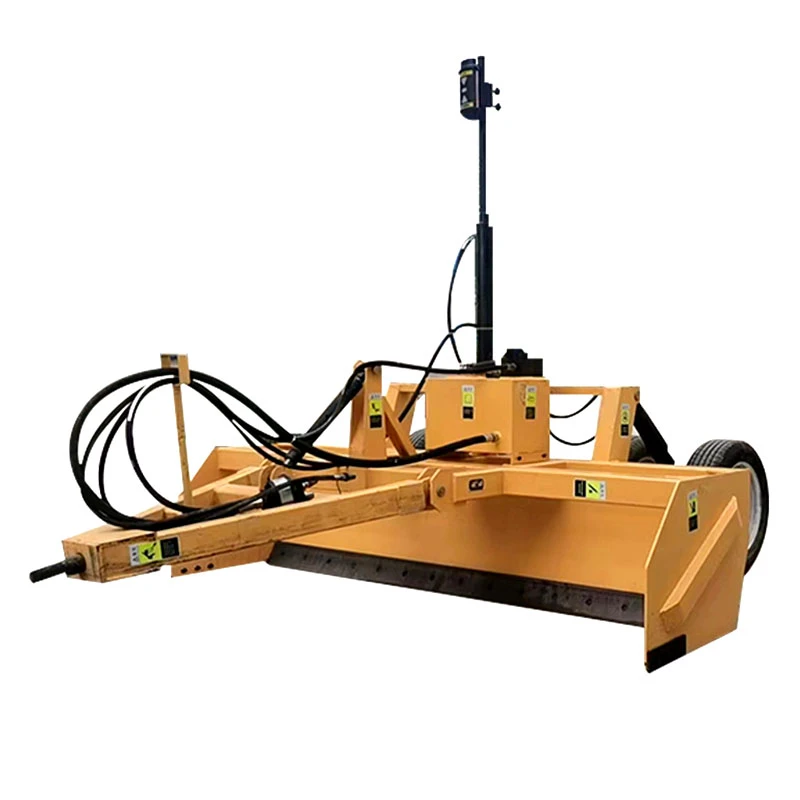
Agricultural laser land leveler is a high-precision land leveling equipment based on laser control technology. Its core technology includes four parts: laser transmitter, receiver, controller and hydraulic actuator system.
Laser transmitter: usually installed on a tripod, emitting a rotating laser beam to form a reference plane (horizontal or inclined), with a coverage range of up to 1000 meters in diameter, and with automatic calibration function.
Receiver: vertically fixed on the mast of the land leveler, capturing laser signals in real time and transmitting them to the controller, with adjustable accuracy (such as ±3mm~±50mm).
Controller: automatically adjusts the hydraulic system according to the receiver signal, controls the lifting and lowering of the blade, and achieves a leveling accuracy of ±2.5cm.
Hydraulic system: matches the tractor power, supports high-frequency lifting operations, and ensures dynamic balance of excavation and filling.
Ⅱ. Industry development history and application status
Technology introduction and localization: In the 1980s, laser leveling technology became popular in the United States and Canada; my country introduced the first set of equipment in 1995 and gradually realized localization after 2010. Representative products such as Liaoning JGP series (2500/2800/4000 models), which integrate American laser technology and domestic hydraulic systems, have been selected into the national agricultural machinery promotion catalog.
Application benefits:
1. Water saving: Irrigation efficiency increased from 40%-50% to 70%-80%, saving 30%-50% of water.
2. Yield increase: Through uniform fertilization and precision irrigation, crop yields increased by 20%-30%.
3. Land saving: Reduce the land area of ridges by 3%-5%, and increase land utilization by 9%.
Application scenario expansion:
From traditional food crops (rice, wheat) to orchards, tea gardens and soil improvement in hilly areas
Ⅲ. Policy drive and market trends
Policy support:
1. Purchase subsidy: Included in the agricultural machinery subsidy catalog to reduce farmers' procurement costs.
2. R&D incentives: Enterprises enjoy the policy of additional deduction of R&D expenses to promote technological iteration.
3. Environmental protection orientation: As green agricultural equipment, it has been promoted as a key agricultural non-point source pollution control project.
Market size: The market size in 2020 is about 10 billion yuan, and it is expected to reach 20 billion yuan in 2025, with an annual compound growth rate of 15%. The regional distribution is mainly in the eastern agriculturally developed provinces, and the potential of the central and western regions is gradually released.
Technology trends:
1. Intelligence: Integrate the Internet of Things and AI to achieve automatic navigation and remote monitoring.
2. New energy: Electric and hybrid models reduce energy consumption and adapt to environmental protection policies.
3. High precision: Phase laser ranging technology is popularized, and the accuracy exceeds ±1cm.
IV. Challenges and coping strategies
Cost pressure: The unit price of imported equipment exceeds one million yuan, and domestic models need to reduce costs through large-scale production.
Technical training: Operators need to master skills such as laser calibration and hydraulic system maintenance, and agricultural technology promotion services need to be strengthened.
Adaptability optimization: Develop customized models for complex terrain (such as hills and clay) to improve environmental compatibility.
V. Future prospects
Laser levelers will become the core equipment for precision agriculture and digital farms. With the integration of Beidou navigation and 5G technology, its application scenarios will further extend to intelligent irrigation and unmanned operations. It is estimated that by 2030, the global market size will exceed 50 billion yuan, and China is expected to occupy more than 40% of the market share with technological iteration and policy dividends.


