

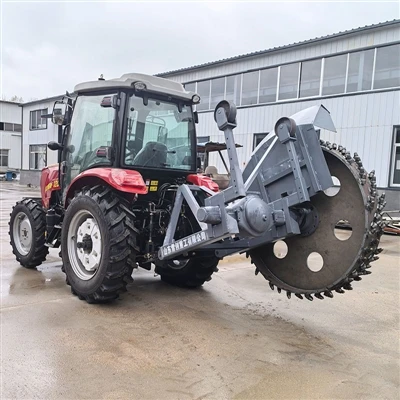

1. Technical principles and product types
Working principle
The disc trenching machine drives the disc equipped with alloy cutters to rotate at high speed (linear speed 7-15 m/s) through the tractor power output shaft, cuts the soil and throws it to both sides of the trench, realizing one-time cutting, crushing and excavation.
Transmission system: Use hydraulic motors or gearboxes to reduce speed and increase torque to adapt to different soil types (such as asphalt pavement requires low gear operation).
Main types
Single disc type: simple structure, one side is equipped with a straight cutting soil knife to assist cutting, and the traction resistance is large.
Double disc type: symmetrical double discs work synchronously, with small traction resistance and more regular trench shape.
Low-speed one-time trenching vs. high-speed multiple trenching: The former has a speed of 50-200 m/h, suitable for hard roads; the latter has a speed of 200-400 m/h, which needs to match the tractor wheelbase and trench width.
2. Core performance advantages
Efficient and precise
The trenching speed reaches 150-700 m/h (3-5 times that of an excavator), the trench depth can reach 1.5 m, the width can be adjusted from 10 to 55 cm, the trench wall is steep and the trench bottom is flat. The crushed soil can be directly backfilled, saving the cost of transporting abandoned soil (the blocky soil of traditional excavators requires secondary treatment).
Economic and environmental protection
Low energy consumption: 0.15-0.45 kWh of energy is consumed for milling 1m³ of soil.
Reduce road damage: complete cutting, crushing and excavation at one time, reducing disturbance to the surrounding environment.
3. Application scenarios and market demand
Infrastructure projects: underground pipelines (water supply, gas), laying of optical cables (urban and rural roads, railways).
Agricultural scenarios: orchard fertilization/drainage ditches (such as apples, vineyards), farmland irrigation canals.
Special needs: 1.2-1.8-meter-deep convex trenches are required for yam/burdock planting.
Market growth drivers Policy support: China's "rural revitalization" and "Belt and Road" infrastructure investment drive demand, and agricultural mechanization subsidy policies are increasing.
Urbanization demand: The global trenching machine market size is expected to exceed US$XX billion in 2025, with the Asia-Pacific region leading the growth rate (dominated by China).
4. Industry challenges and technology trends
Existing problems
Technical bottlenecks: Insufficient adaptability to complex geology (rock layers) and fast tool wear.
Cost pressure: High-end models are priced at RMB 18,000-19,000 per unit, and procurement by small and medium-sized enterprises is limited.
Innovation direction
Intelligent upgrade: Integrated GPS positioning, automatic leveling, and remote fault diagnosis to improve accuracy and safety.
Green manufacturing: Lightweight design, new energy power (electric models are under development), responding to the "dual carbon" policy.
Modular expansion: Compatible with a variety of tool and disc sizes to achieve "one machine, multiple trench types".
5. Competition pattern and industrial chain
Industrial chain structure
Upstream: suppliers of special steel, hydraulic systems, and alloy tools.
Midstream: complete machine manufacturers, such as small enterprises focusing on cost-effectiveness, and leading enterprises focusing on intelligent layout.
Downstream: engineering contractors, agricultural cooperatives, and municipal units.
Competitive strategy
Differentiation breakthrough: avoid homogeneous price wars, focus on deep trench models or special scenarios (such as mountain orchards).
Service extension: provide integrated services such as leasing, tool replacement, and operation training to enhance customer stickiness.
6. Future prospects
Short term: rural water supply transformation and 5G optical cable laying generate new orders.
Long term: combine AI to achieve unmanned operation and expand new scenarios such as mine dredging and ecological restoration.


