


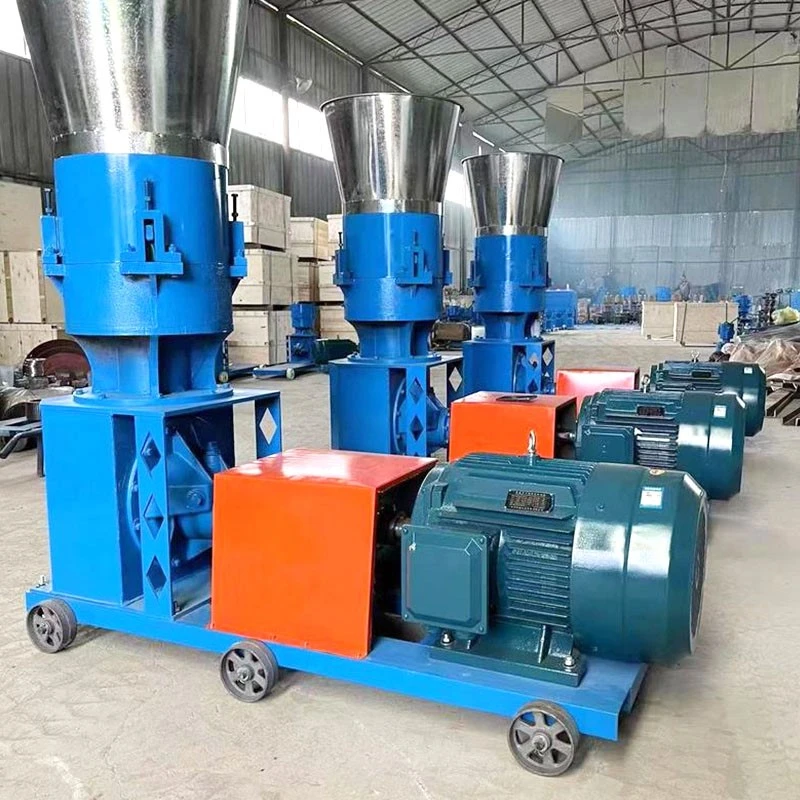
1. Overview of the feed pellet machine industry
Feed pellet machines are professional equipment that compress powdered or broken feed raw materials (such as corn, straw, grass powder, etc.) into pellets. Its core value lies in improving feed utilization, reducing waste, facilitating storage and transportation, and killing pathogenic microorganisms through high-temperature gelatinization process to improve animal digestion and absorption rate.
1.1 Development background
Demand drive: The large-scale development of the breeding industry promotes the demand for efficient feed processing equipment, especially the significant growth rate of aquatic feed (annual average of 17%), far exceeding the overall growth rate of compound feed (8%).
Policy support: The country encourages agricultural modernization, provides subsidies for environmentally friendly and energy-saving equipment, and promotes industry technology upgrades.
Global market: The global market size in 2023 is about US$190 million, and it is expected to reach US$300 million in 2030, with a compound annual growth rate of 4.7%.
1.2 Product classification
Type Features Application scenarios
Ring die pelletizer: high production capacity, good pellet finish, adjustable compression ratio; but the price is relatively high, large and medium-sized feed mills, large-scale farms
Flat die pelletizer: simple structure, low cost, suitable for high-fiber raw materials; uneven wear, small and medium-sized farms, family farms
Conical roller pelletizer: inclined wheel design reduces friction resistance, extends mold life, energy-saving and high efficiency, organic fertilizer, biomass fuel pellet production
II. Technology core and innovation trend
2.1 Working principle
Feed pellet machine realizes molding through the combination of physical pressure and heat energy:
Gelatinization reaction: The roller and the template extrude the material, gelatinize the starch and denature the protein at a high temperature of 75-85℃, and improve the nutritional utilization rate of the feed.
Structural design: The ring die machine uses 2-3 rollers to rotate and extrude the material through the die hole; the flat die machine relies on the horizontal movement of the roller to form.
2.2 Key technological breakthroughs
Intelligent control: integrated PLC system and Internet of Things technology to achieve remote monitoring, fault diagnosis and automatic conditioning.
Environmental protection and energy saving: new low-noise motors and clean production processes reduce energy consumption by 30%, meeting carbon emission standards.
Multi-functional integration: integrated design of crushing, mixing and granulation to reduce losses in intermediate links.
2.3 Particle quality control
Raw material grinding fineness: The higher the fineness, the more complete the starch gelatinization and the higher the particle hardness (especially suitable for aquatic feed)
Steam conditioning: The best temperature is 80-85℃ and the moisture content is 15-16%. Prolonging the conditioning time can enhance the particle density
Die parameters: The pore size (2-12mm), compression ratio (7-9 times the pore size), and material (alloy steel wear resistance) determine the particle shape
III. Market structure and competition situation
3.1 Regional market characteristics
Domestic distribution: East China, South China, and North China are industrial agglomeration areas, accounting for more than 60% of the market share (market size of 12 billion yuan in 2019).
International expansion: "One Belt, One Road" promotes export growth, and Southeast Asia and Africa become emerging markets.
3.2 Focus of enterprise competition
Technical barriers: The high-end market of ring die machines is dominated by European and American companies, and domestic companies seize the low-end and mid-end markets with cost-effectiveness.
Homogeneity challenge: Small and medium-sized manufacturers are caught in a price war, and leading companies break through through customized services (such as special models for aquaculture).
Ⅳ, future trends and challenges
4.1 Growth drivers
Upgrade of breeding structure: The proportion of intensive breeding has increased, and the demand for large pellet machines has increased by an average annual rate of 10%.
Green feed revolution: Microbial fermentation feed and straw recycling promote the development of environmentally friendly equipment.
4.2 Industry pain points
Talent gap: Insufficient talent in intelligent equipment operation and maintenance and process optimization.
Raw material fluctuations: The prices of core materials such as alloy steel affect production costs.
4.3 Technology evolution direction
Predictive maintenance: AI algorithms predict equipment loss and reduce downtime.
Biological compatibility: Develop special modules for different animals (such as ruminants and aquatic products).
V. Conclusion: Industry Value and Investment Logic Feed pellet machines are key equipment that connects agricultural resources and breeding efficiency. Their development directly responds to the national strategies of "food security" and "low-carbon agriculture". Investors should pay attention to:
Technology moat companies: manufacturers with intelligent control and low-energy patented technologies;
Vertical field deep cultivators: customized solution providers for subdivided tracks such as aquatic products and pet feed;
Global layout capabilities: brands that rely on the "Belt and Road" to expand into emerging markets.


