


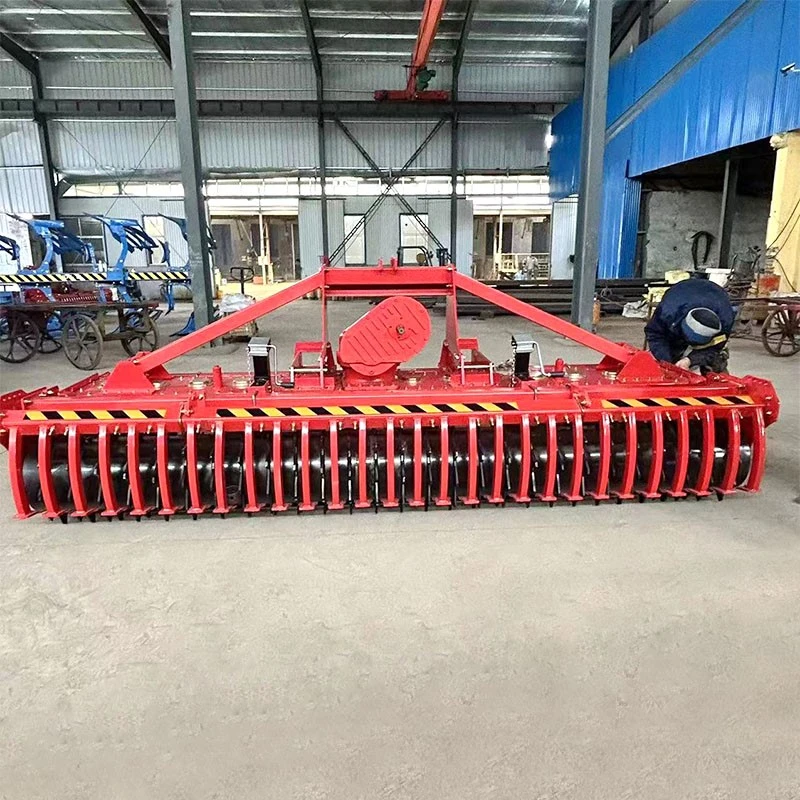
1. Main structural components
The driving harrow is mainly composed of the following core components:
Power input device: The power is transmitted through the tractor PTO (power output shaft) to drive the harrow teeth or the pressure roller to rotate.
Harrow tooth group: Usually made of high-carbon steel or alloy steel, arranged in a spiral or linear shape, used to break soil clods and loosen soil.
Pressing roller: Located behind the harrow teeth, it is used to compact the soil surface and reduce water evaporation.
Adjustment mechanism: Including depth adjustment plate and hydraulic control system, which can adjust the depth of harrow teeth into the soil and the intensity of operation.
Frame and suspension device: Connect the tractor's three-point suspension system to ensure stability and maneuverability.
2. Working principle
The tractor power drives the harrow teeth to rotate at high speed through the PTO. After the harrow teeth cut into the soil, they break it and throw it backwards, while the pressure roller follows closely to compact the surface soil. Some high-end models are equipped with a hydraulic adjustment system, which can adjust the working depth in real time to adapt to different soil conditions.
3. Application advantages
Efficient soil crushing: Compared with traditional disc harrows, driven harrows have faster operation speed and more uniform soil crushing effect.
Moisture conservation and energy saving: The pressure roller can reduce soil moisture loss and reduce the need for subsequent irrigation.
One machine for multiple purposes: Some models can be equipped with sowing or fertilization devices to achieve joint operation.
4. Maintenance and precautions
Regular lubrication: Check the bearings and transmission parts to ensure good lubrication.
Rake tooth inspection: Severely worn rake teeth need to be replaced in time to avoid affecting the soil crushing effect.
Operation adjustment: Reasonably adjust the depth according to the soil moisture and hardness to avoid overload or rake tooth damage.
Conclusion
Driven harrows have become an important tool for modern precision agriculture due to their high efficiency and energy saving. Reasonable selection and scientific maintenance can significantly extend their service life and improve operation efficiency.


