

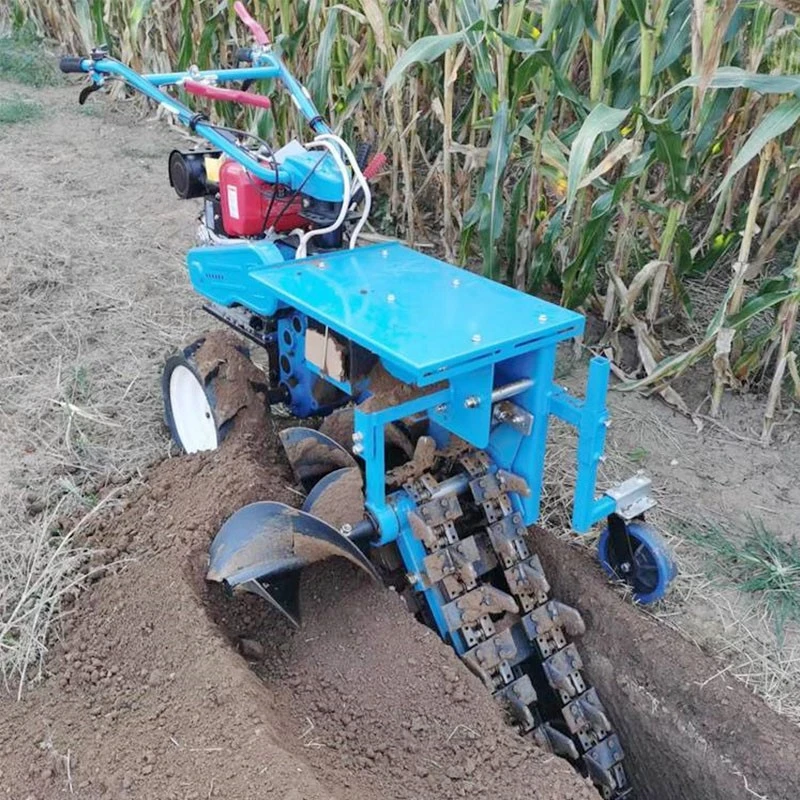
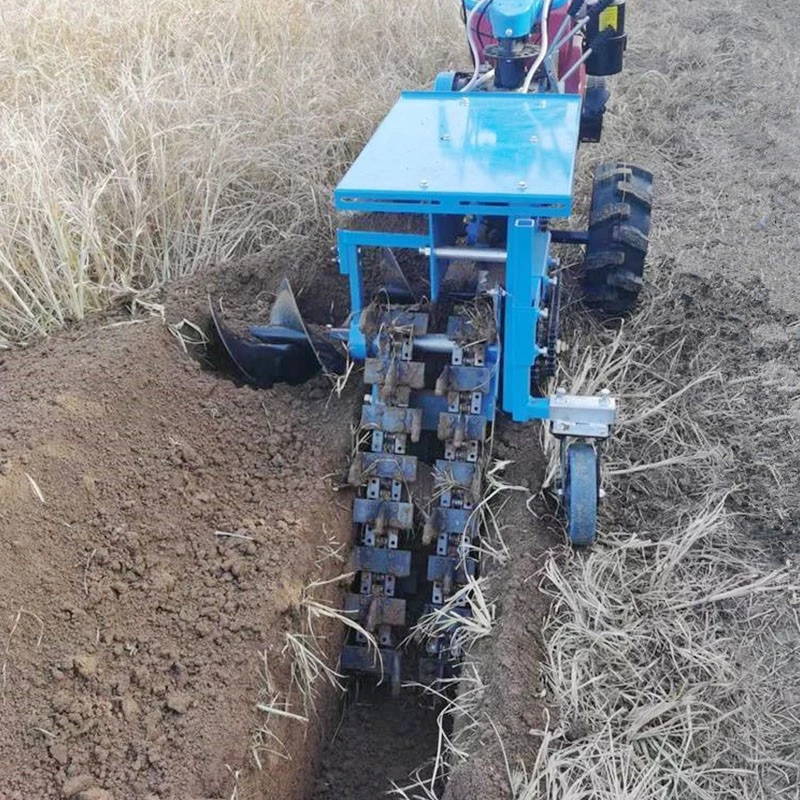
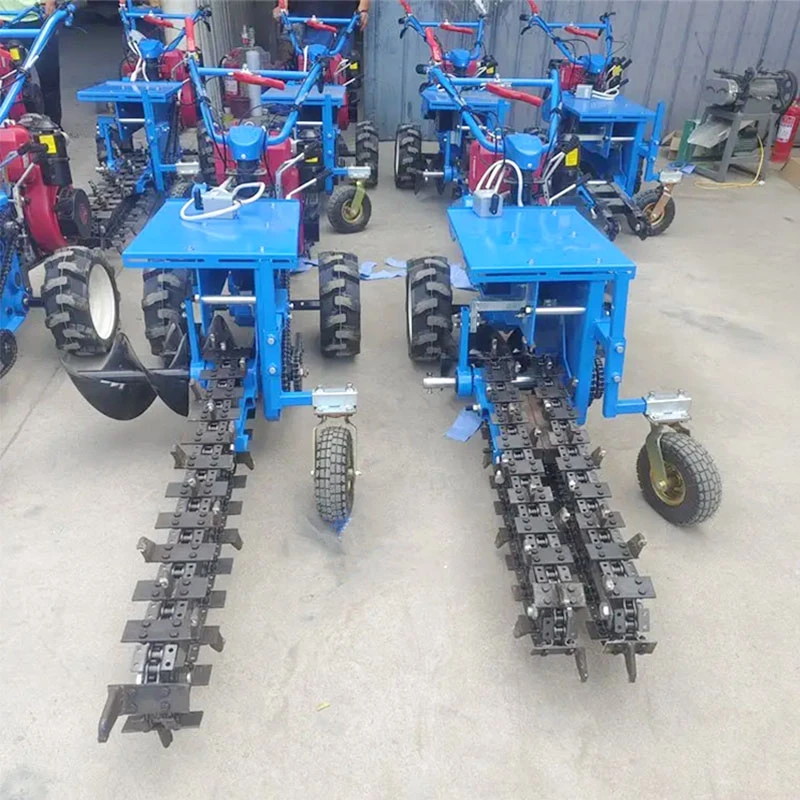
1. Preparation and inspection before trenching with hand-held chain trencher
Safety inspection and environmental survey:
Wear labor protection products that meet the standards: non-slip labor protection shoes, work gloves, safety glasses, hearing protection devices (earplugs/earmuffs), tight work clothes (avoid loose clothing being caught).
Clean up the work area: remove stones, tree roots, metal fragments and other foreign objects that may damage the chain or cause danger.
Confirm the underground situation: Try to understand whether there are pipelines (electrical wires, water pipes, gas pipelines, etc.) underground. It is strictly forbidden to construct in areas where the underground conditions are unknown.
Evaluate the soil quality and slope: Hard frozen soil, rocks or steep slopes may exceed the machine's capabilities or cause danger. Special attention should be paid to anti-slip on slippery ground. Make sure there are no idle people in the work area, especially children and pets.
Equipment inspection:
Fuel and engine oil: Use fuel of the specified grade and check the fuel tank to ensure that it is sufficient. Check the oil level in the engine oil tank.
Chain and sprocket: Check the tension of the chain: Press down on the middle of the chain, and there should be about 1cm of vertical movement. Too loose will cause the chain to fall off easily, and too tight will increase wear. Adjust the tension nut according to the instructions.
Visually inspect the chain: Confirm that there is no severe wear, deformation, cracking or broken teeth. Check whether the sprocket tooth shape is intact and not excessively worn. Apply special chain lubricant to the chain.
Protective cover: Confirm that all protective covers are properly installed, fixed and not damaged. Do not remove the protective device without authorization!
Operating mechanism: Test whether the throttle switch, flameout switch, and clutch handle (if any) are flexible and return to their original position normally.
Cutter head/sprocket: Check whether the grooving teeth (cutter head) are firmly installed, not missing or excessively worn.
Traveling wheel/track (if any): Check the air pressure or track tension and wear.
Bolt/nut tightening: Quickly check whether the bolts and nuts of the key parts of the machine (handrails, engine base, cutter head bracket, etc.) are loose.
Cooling/air intake: Check and clean the engine block cooling fins and air filter (very important, dirty filter element will cause power loss and cylinder pulling).
2. Hand-held chain trencher to start the engine
Place the equipment: Place the trencher horizontally on a solid, flat ground, making sure the chain is off the ground and there are no obstacles in front.
Switch setting: Put the flameout switch (if any) in the "ON" (run) position.
Damper/choke: (cold engine start): It is usually necessary to close the damper (Choke) to the appropriate position (depending on the starting ambient temperature, it may need to be fully closed or half open).
Starting method: Electric start: Insert the key (if any), turn it to the start position, or press the start button.
Hand pull start: Gently pull the hand pull rope to the resistance point (feel the compression), and then pull it quickly and forcefully. Pay attention to your posture, stand firmly and hold the handrails. After starting, return to the position naturally with the rope.
Warm up the engine and adjust the throttle: After starting, let the engine run at low throttle idle for about 30-60 seconds to preheat. After preheating, gradually push the throttle back or fully open (OPEN).
Note: It is strictly forbidden to touch the chain when the engine is running!
3. Operation steps for trenching with hand-held chain trencher
Positioning and alignment: Determine the starting point and direction of trenching (lime can be used to draw lines for guidance). Align the machine so that the chain is aligned with the predetermined trenching line. Hold the handrails tightly with both hands, stand firmly, and maintain a natural, slightly forward posture.
Start walking and chain: First, fully engage the clutch handle (if the clutch controls walking), slowly increase the throttle, and let the machine move forward at a low speed. Sudden engagement of the chain is strictly prohibited during travel! After the machine is moving at a stable low speed (about 3-5 meters), slowly engage the chain drive handle/rod (the most important safety step!). Slowly increase the throttle while engaging to gradually rotate the chain.
Smooth trenching:Maintain low to medium speed (usually no more than half the throttle), extremely slowly and steadily lower the joystick so that the front end of the rotating chain gently contacts and cuts into the soil.
Key points: Never use excessive force or press down quickly! Too much force in the soil is the main cause of violent machine jumping, chain breakage, engine flameout, and even operator loss of control and falling.
Stable trenching: After the chain is fully in the soil to the required depth (achieved by adjusting the angle of the down-pressure rod or the depth-limiting wheel), keep the throttle stable (not too large), and the machine moves forward at a constant speed. Hold the handrail firmly with both hands, make fine adjustments according to the resistance and direction feedback from the machine, and keep moving in a straight line. Avoid sharp turns. Keep your eyes on the guide line 1-2 meters ahead, and use your peripheral vision to pay attention to the ditching situation. It is strictly forbidden to look down at the chain!
Steering and obstacle avoidance:
Small angle steering: Be sure to reduce the throttle first (reduce the chain speed and resistance), and then slowly deflect the handrail in the desired direction. The steering angle should not be too large. In case of obstacles such as large rocks and tree roots: You must stop moving forward and release the chain drive immediately, lift the chain over the obstacle or clear it before continuing. Never try to force the chain to bite hard!
Adjust the depth and width:
Depth: During stable travel, it is achieved by fine-tuning the angle of the downward control lever. Deepen slowly to lift, and reduce slowly to relax.
Width: Usually determined by the width of the chain itself. If you need to be wider, you need to perform multiple parallel operations (pay attention to the interval). Reach the end point: First completely release the chain drive handle/bar to stop cutting the chain off the ground. Then release the travel clutch (if there is a separate control) or reduce the throttle to stop the machine from moving.
4. Completion and shutdown of the hand-held chain trencher
Leave the work area: Move the machine from the trench to a flat and open area.
Idle cooling: Let the engine run at idle speed for 1-2 minutes (especially after high-load operation).
Shut down the engine: Put the flameout switch in the "OFF" position or press the stop button. Wait for the engine to stop completely.
Inspect the equipment: Quickly visually check whether the chain and the teeth are intact and whether there are any abnormalities (such as oil leakage, loose parts, etc.).
Note: The chain may still be warm at this time!
Cleaning the equipment: Clear the weeds and soil wrapped around the machine (especially the chain, heat sink, and guard plate).
5. Maintenance points of hand-held chain trenchers (daily/after each use)
Cleaning: Thoroughly remove the soil and weeds.
Chain: Check tension and wear, and lubricate immediately (use special chain lubricant).
Teeth/chain: Check for wear and damage, and replace if necessary.
Air filter: Clean after each operation! According to the degree of dirtiness in the environment (more frequent when there is a lot of sand and dust), remove the filter element, gently pat it or blow it clean with low-pressure compressed air (from the inside to the outside). The foam filter element can be cleaned with soapy water (not gasoline), dried, and then coated with an appropriate amount of specified engine oil. The filter cotton needs to be replaced.
Bolts and nuts: Check and tighten key parts.
Fuel system: If it is not used for a long time (more than 1 month), drain the fuel in the fuel tank and carburetor (or add special stabilizer).
Storage: Park in a dry, rain-proof, and safe place (such as a warehouse or shed). Avoid the chain directly touching the ground.
6. Safety warnings and prohibitions for hand-held chain trenchers (again emphasized)
Do not disassemble or render them ineffective at any time.
When the engine is running, it is strictly forbidden to approach, touch, check or adjust the chain! All adjustments, cleaning and maintenance must be performed after the engine is completely stopped and cooled.
During operation, both hands must hold the handrails tightly, both feet must stand firmly, and attention must be focused.
It is forbidden to operate under the influence of alcohol, drugs or when extremely tired.
It is forbidden to overspeed the engine (too much throttle).
It is forbidden to work on slopes (especially horizontally) to avoid the risk of sliding or rolling.
It is forbidden for a single person to perform heavy load operations beyond their physical strength (such as hard ground requires multiple attempts).
Pay close attention to the status of the machine: abnormal vibration, abnormal noise, thick smoke, etc. are all serious warning signals, and the machine must be stopped and checked immediately!


