


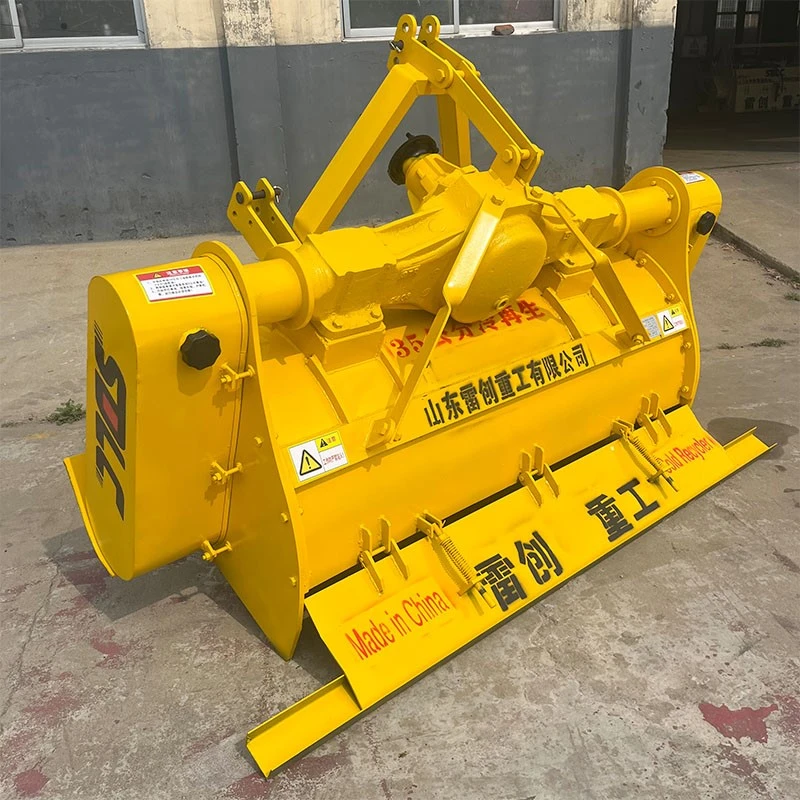
I. Working principle and maintenance importance of lime soil mixer
The lime soil mixer uses mechanical force to evenly mix soil and lime, triggering the following chemical reactions:
Drying stage: Quicklime (CaO) releases heat when it meets water, reducing soil moisture content.
Modification stage: Calcium ions replace water molecules on the surface of clay particles, reducing the plasticity index (such as the significant decrease of PI from 180% in the case).
Stabilization stage: Cementing substances such as calcium silicate hydrate (CSH) are generated to improve soil bearing capacity.
If the equipment is in contact with high alkaline materials (pH>10.5) for a long time, improper maintenance may cause corrosion, wear or transmission failure of components.
II. Key points of daily maintenance
1. Cleaning management
Immediate cleaning: Immediately remove the accumulated materials on the mixing drum, blades and discharge door after shutdown to prevent lime from hardening and agglomeration (cleaning becomes more difficult after hardening). Use low-pressure water for flushing to avoid high-pressure water damaging the bearing seal; wipe electrical components with a dry cloth.
Dust prevention: Clean the motor heat sink and control cabinet dust regularly to ensure heat dissipation (dust accumulation may cause the motor to overheat and shut down).
2. Inspection of key components
Stirring blades: wear amount, gap with liner (>10mm needs to be adjusted); gap adjusted to ≤6mm, replace when severely worn
Transmission system: gear/chain lubrication status, V-belt tightness (press down 10–15mm is best); add lithium-based grease lubricant and adjust tensioner
Sealing system: shaft end seal leakage, bearing temperature rise (>60℃ abnormal); stop and replace oil seal, add high temperature resistant sealing grease
Electrical components: loose terminal, overload protection function; tighten terminals every month and test protection devices
3. Lubrication specifications
Lubrication points: bearing seat, reducer, chain hinge.
Cycle and materials:
Bearings: add alkali-resistant grease (such as molybdenum disulfide) every 8 hours.
Reducer: Replace the gear oil (ISO VG220 grade) every 500 hours.
It is forbidden to mix grease to avoid chemical reaction failure.
III. Regular in-depth maintenance plan
Weekly inspection: Calibrate the stirring speed meter and detect the pressure of the hydraulic system. Clean the admixture feeding pipeline to prevent lime crystallization and blockage.
Monthly inspection: Dismantle and inspect the connecting bolts of the stirring arm and tighten them to the standard value (refer to ASTM D3551). Test the thickness of the brake friction plate (<2mm replacement).
Annual inspection: Replace the wear parts (blades, linings, etc.) and perform dynamic balance tests. Entrust a third party to verify the motor power output and energy consumption.
IV. Safe operation and emergency response to failure
Operation specification: Confirm that the emergency stop button is reset before starting and the guard is intact. It is strictly forbidden to reach into the cylinder during operation (risk of inertial rotation of the blade).
Troubleshooting: Abnormal vibration: blade wear imbalance/loose foundation; stop to adjust the gap, tighten the anchor bolts Motor overload trip: material overload or bearing stuck; clear the blockage, manually turn the wheel to test the resistance
V. Suggestions for extending equipment life
Material adaptation: When dealing with high-viscosity soil (such as montmorillonite content>40%), use high-calcium lime (Ca(OH)₂≥94%) to reduce wear.
Environmental control: Avoid parking equipment in an environment with humidity>80% to prevent lime from absorbing moisture and corroding metal.
Professional training: Operators need to master the ASTM D6276 lime dosage test method and accurately control the ratio (excessive lime accelerates component wear).


