


I. Product definition and core value
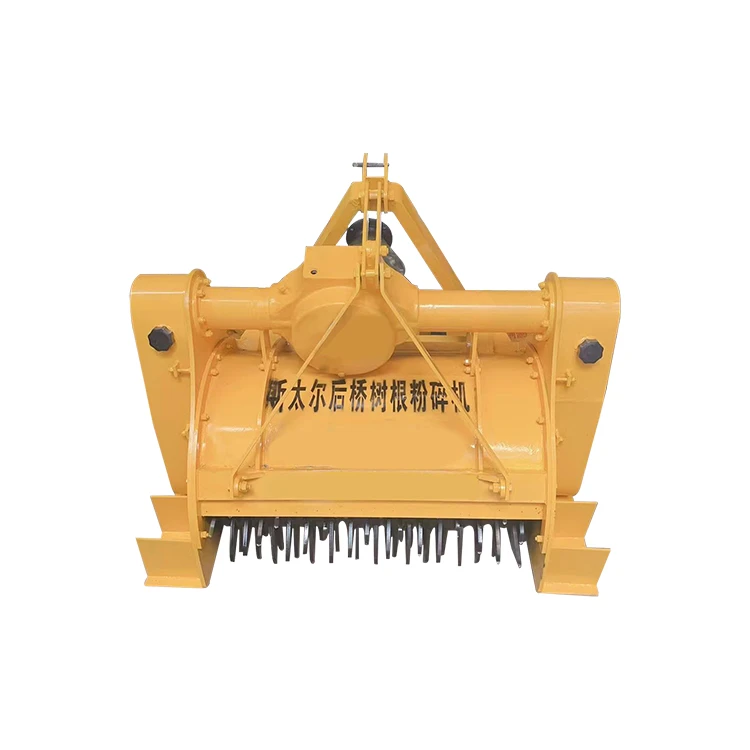
The tractor root crusher is a suspended mechanical equipment powered by an agricultural tractor. The crushing device is driven by the tractor power output shaft (PTO) to crush woody waste such as roots, branches, and stumps into debris or wood powder. Its core value lies in: Resource recycling: converting waste tree roots in gardens, orchards, and forest farms into organic mulch or biomass fuel to reduce landfill pollution.
Operation efficiency: directly suspended behind the tractor, flexible to move, suitable for complex terrains such as fields and slopes, without the need for additional transportation equipment.
Environmental protection and emission reduction: dust removal design is integrated in the crushing process to reduce dust pollution, which is in line with the policy orientation of green agriculture.
II. Technological evolution and product innovation
Power transmission method: The tractor PTO shaft is used to transmit power, suitable for 16-45 horsepower tractors, and the knife roller is driven to rotate at high speed (speed of about 2000r/min) through belt or connecting rod shaft transmission. Some high-end models are equipped with hydraulic systems to achieve automatic adjustment of the knife roller lifting and feeding speed to adapt to different hardness of tree roots.
Crushing structure design
Blade system: It mostly adopts a double-sided blade flying knife + bottom knife combination (such as 2 flying knives + 1 bottom knife), which can crush fresh and soft branches or roots with a diameter of ≤10cm.
Disc crushing technology: Through the offset feed port and rotating feed teeth, the material is evenly distributed, combined with the secondary crushing of the screen, the uniformity of the debris is improved (particle size ≤30mm).
Intelligent upgrade
The new model integrates the Internet of Things (IoT) technology to support remote fault diagnosis and operation parameter adjustment. Frequency conversion technology prevents overload, automatically reverses the feed hopper when encountering resistance, and protects the core components.
III. Application scenarios and benefit analysis
Orchard management: Pruning branches and crushing them back to the field can increase soil organic matter, reduce fertilizer costs by 30%, and reduce manual cleaning costs.
Forestry waste treatment: After logging, tree stumps are crushed on site to avoid fire hazards, and wood chips are sold as biomass fuel to create additional income.
Municipal greening: Park and street tree maintenance, debris covers the exposed surface, suppresses dust, and saves garbage removal costs.
IV. Operation specifications and safety guidelines
Before operation: Check the integrity of the blade and the tightness of the drive belt to ensure that the tractor is suspended firmly.
During operation: Maintain a constant speed and avoid sharp turns; it is forbidden to use on slippery terrain in rainy days to prevent rollover risks.
Maintenance points: Regularly clean up residual debris, add lubricating oil to the bearing parts, and extend the life of the equipment.
Conclusion
As the "green engine" for agricultural and forestry waste treatment, the tractor root crusher is upgrading from a single-function device to an intelligent and integrated system through the dual-wheel drive of technological innovation and policy dividends. In the future, as the carbon neutrality development goal deepens, its resource circulation value will be further released and become a key infrastructure for ecological agriculture and sustainable urbanization.


