

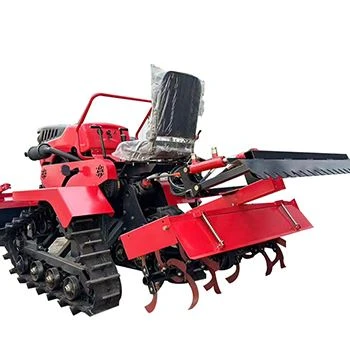
Crawler tractors are different from wheeled tractors in that they are supported on the ground by a wound circular crawler track. The crawler track contacts the ground, the spikes are inserted into the soil, and the drive wheel is not grounded. Under the action of the driving torque, the drive wheel continuously rolls up the crawler track from the rear through the meshing between the gear teeth on the drive wheel and the track plate joint pin. The grounded part of the crawler track exerts a backward force on the ground, and correspondingly gives the crawler track a forward reaction force, which is the driving force that pushes the tractor forward.
The driving force of a wheeled tractor is directly transmitted to the traveling wheel, while the crawler tractor is different in that its driving force is transmitted to the axle of the driving wheel through the crawler track wound on the driving wheel, and then transmitted to the driving wheel through the axle through the tractor body. When the driving force is sufficient to overcome the rolling resistance and the traction resistance of the agricultural implements carried, the supporting wheels roll forward on the surface of the crawler track, thereby driving the tractor forward. Since the driving wheel continuously rolls the crawler track to the front section by section, and then lays it on the ground through the guide wheel, the supporting wheel can continuously roll on the track laid by the crawler track. It can be seen that the driving of the crawler tractor is achieved by the interaction between the crawler track and the ground through the driving wheel, and the driving force is greater than the sum of the rolling resistance and the traction resistance.


